Suggested Upper Merged Ontology (SUMO)

    [Home | Browse | Download | Publications | Projects | Tools | What‘s New | About]

    The first annual SUMO Reasoning Prize is part of the The CADE ATP System Competition at CADE 2008. $3000 in prizes will be awarded to the best reasoning performance on a set of SUMO-based tests.

    The 2008 SUMO prize, worth $3000, is due Dec 1, 2008. Congratulations to the 2007 SUMO prize winners at Shahid Beheshti University, for an ontology of the software Capability Maturity Model

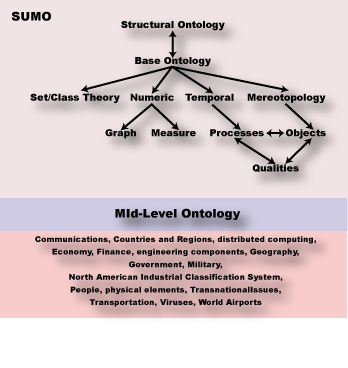
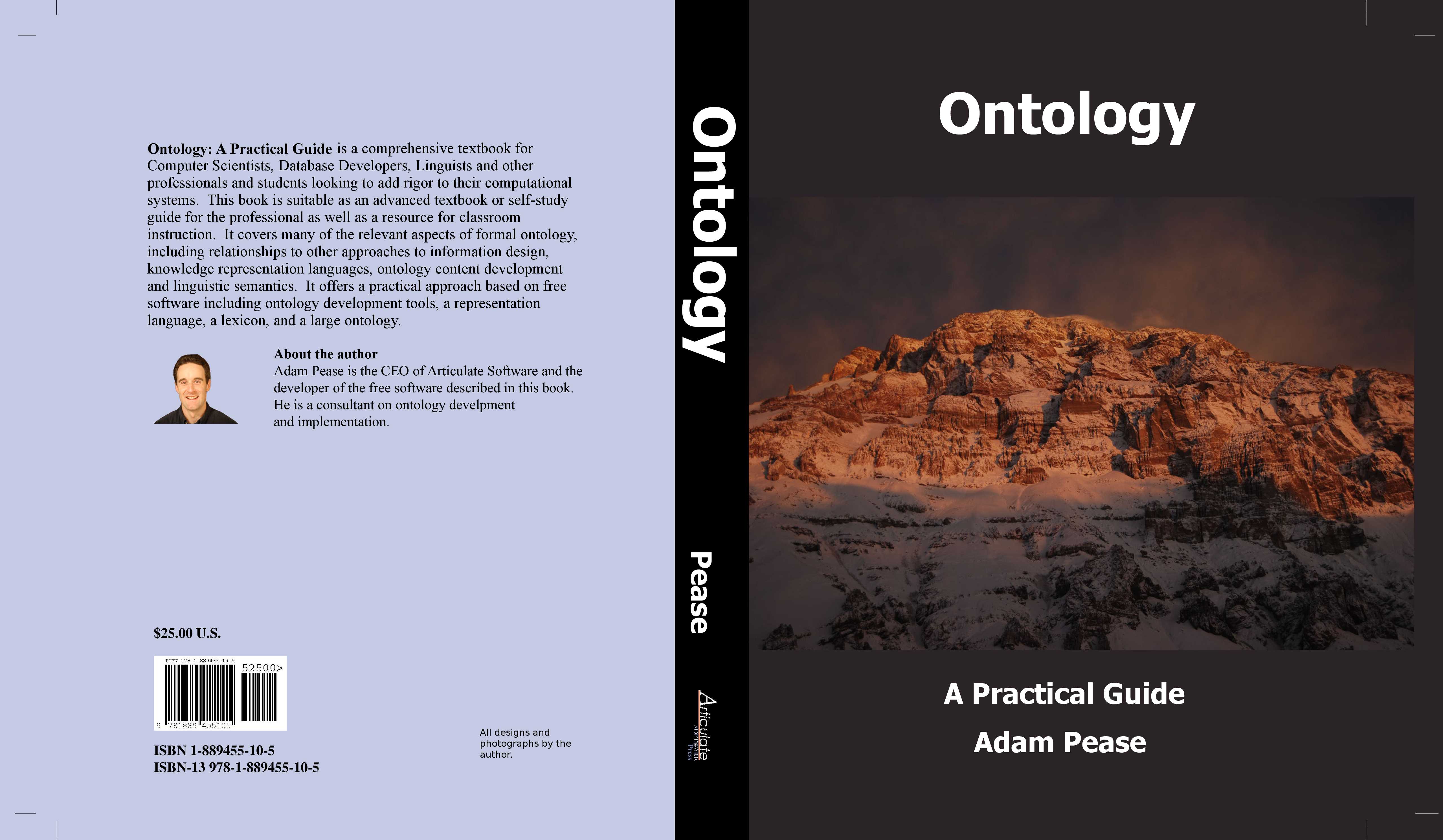
    The Suggested Upper Merged Ontology (SUMO) and its domain ontologies form the largest formal public ontology in existence today. They are being used for research and applications in search, linguistics and reasoning. SUMO is the only formal ontology that has been mapped to all of the WordNet lexicon. SUMO is written in the SUO-KIF language. SUMO is free and owned by the IEEE. The ontologies that extend SUMO are available under GNU General Public License. Adam Pease is the Technical Editor of SUMO.

    Find an English word and its corresponding formal term in SUMO:
    English Word: 

    Features
    • Mappings to all of WordNet
    • Language generation templates for Hindi, Chinese, Italian, German, Czech and English
    • Tool support for browsing and editing
    • Largest free, formal ontology available, with 20,000 terms and 70,000 axioms when all domain ontologies are combined. These consist of SUMO itself, the MId-Level Ontology (MILO), and ontologies of Communications, Countries and Regions, distributed computing, Economy, Finance, engineering components, Geography, Government, Military (general, devices, processes, people), North American Industrial Classification System, People, physical elements, TransnationalIssues, Transportation, Viruses, World Airports A-K, World Airports L-Z, WMD. See also a large amount of instance content from DBPedia about people. Additional ontologies of terrorism are available on request.
    • Richly axiomatized, not just a taxonomy. All terms are formally defined. Meanings are not dependent on a particular inference implementation. An inference and ontology management system however is provided. An additional system that supports visual editing, and does a better job of displaying the ontologies, especially in non-Western languages is the KSMSA system.

    Documentation and other resources

    • An introductory tutorial on KIF and SUMO is available with slides and audio (See also an older version of the tutorial slides and accompanying audio part 1 part 2 )
    • View a portion of the SUMO hierarchy
    • look at historical versions of SUMO
    • We ask that people working with SUMO cite our primary paper in any publications
    • Conformance testing for SUMO
    • Translation of SUMO into OWL
    • Some thoughts on an ontology development process and ontology development pitfalls
    • Frequently asked questions
    • A word sense frequency analysis based on WordNet SemCor that can be used for simple word sense disambiguation. This was done on WN 1.6 but could be rerun with the automatic remappings to 2.0
    • A very big graph of the taxonomy in SUMO v 1.75 (too big to display in a broswer, download and view in a drawing application)

    Webmaster

    Hosted by CIM3.NET